A career change resume summary should explain the connection between your actual experience and the role you want. You do not need to rename your past jobs or write as though you already work in the new field. You need a few specific sentences that make your relevant work easier to recognise.
The summary is optional. Use it when the connection would otherwise be hard to see. This guide gives you a writing framework, three hypothetical before-and-after examples, and a way to check every claim against the rest of your resume. The examples illustrate wording, not real candidates or measured hiring outcomes.
Key takeaways
Map each sentence in your summary to specific evidence from your work history, not vague claims like 'proven leader' or 'results-driven'.
You can include relevant coursework or projects, but clearly label them as such, not as employment.
Always preserve your actual job titles and credentials; never claim the target title as prior employment.
A summary is optional; omit it if it merely repeats headings or adds unsupported adjectives.
Use the summary to clarify a less obvious career connection, not to invent a new professional identity.

How to write a career-change resume summary
Start with the work in the target job description. Choose the responsibilities you can connect to something you have actually done. For a coordination role, that might be scheduling, following up actions or preparing documentation. Do not copy every requirement into your summary.
Write down the evidence before the wording. For each responsibility, name the task you performed, its context and your level of ownership. “Prepared meeting notes and followed up open actions” supports coordination experience. It does not establish that you managed the entire project.
Separate direct experience, transferable experience and learning. Direct experience means you have done the relevant work. Transferable experience uses a related skill in a different setting. Coursework and personal projects can demonstrate practice, but should keep those labels. Match the claim to the evidence rather than forcing every example into professional experience.
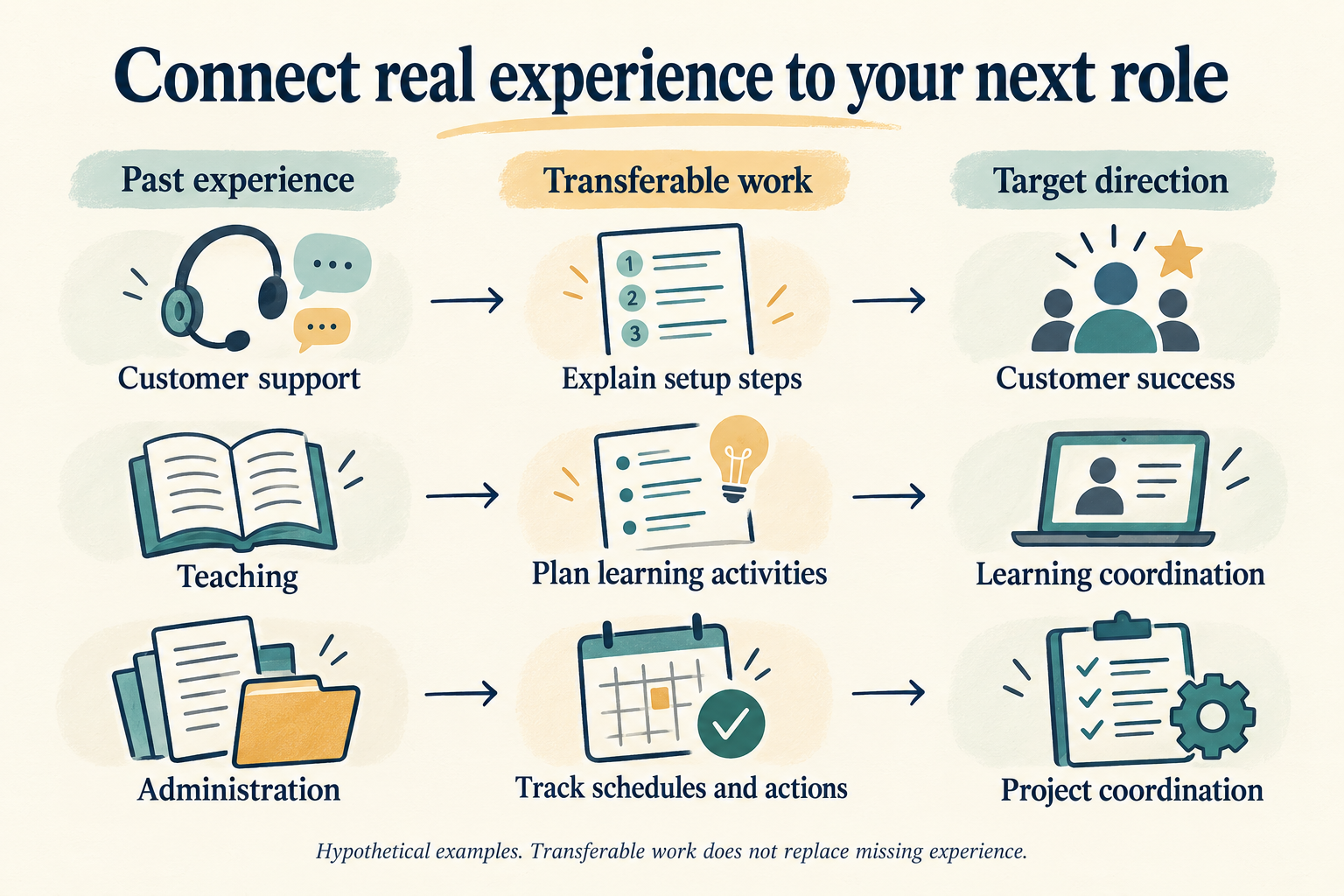
Select the clearest connection. Suppose a job asks for help with onboarding customers and your support role included explaining setup steps. The defensible connection is experience helping users get started. It is not proof that you owned an onboarding programme or customer retention targets.
Draft the paragraph and test it against your work history. State your actual background, describe the relevant work, and make the new direction clear. For the wider resume, use our guide to tailoring your resume to a job description without inventing experience.
A framework you can adapt without copying claims
Build your career change resume summary around three pieces: your actual background, the relevant work you have done, and the direction you are targeting. You can change the order. The point is to make the connection explicit without turning a goal into a credential.
Start with a concrete description such as “teacher with experience planning lessons and coordinating learning activities.” Follow it with the work most relevant to the new role. If the transition is still unclear, add a short statement of direction: “Seeking to bring that planning experience to a learning coordinator role.”
Leave out adjectives that need the reader to take your word for them. “Organised” is less useful than a description of maintaining schedules and following up actions. A phrase such as “experienced project manager” also carries a different claim from “administrative assistant with coordination experience.” Use the wording your work can support.
You do not have to include years of experience. If you do, calculate them from the relevant work and avoid implying that years in one field are years in the target profession. This is a drafting framework, not a required resume format. Follow any instructions in the application.
Three before-and-after examples
Customer support to customer success
Hypothetical background: The person answered support questions, documented recurring issues, explained setup steps and escalated unresolved cases. Nothing in this example establishes ownership of customer renewals, sales or retention targets.
Before: “Dedicated professional looking to transition into customer success, with strong communication and problem-solving skills.”
After: “Customer support specialist with experience answering product questions, explaining setup steps and documenting recurring issues. Worked with technical teams by escalating unresolved cases. Seeking to bring this customer communication experience to a customer success role.”
The first sentence names relevant customer-facing work. The second shows a specific handoff rather than claiming broad leadership. The last states a goal, not a job title the person has already held.
If the vacancy requires renewal negotiation or responsibility for a customer portfolio, this summary does not prove those requirements. Treat them as gaps to investigate. Do not add them just because they appear in the job description.
Teaching to learning coordination
Hypothetical background: The teacher planned lessons, adapted materials in response to learner questions, scheduled activities and tracked assignment completion. The example does not include corporate training experience or an instructional-design qualification.
Before: “Passionate educator eager to move into corporate learning and development.”
After: “Teacher with experience planning lessons, adapting learning materials and scheduling learning activities. Tracked assignment completion to organise follow-up work. Seeking to apply this planning and coordination experience in a learning coordinator role.”
This version names work that can connect to a coordination role without erasing the classroom setting. The phrase “teacher with experience” preserves the person’s background. It does not turn classroom teaching into employment as a corporate trainer.
Check the vacancy’s actual responsibilities. Managing course bookings, maintaining a learning system and facilitating training are different tasks. Your experience may connect to some of them, while others require further learning. If you have completed a relevant course or project, identify it separately rather than implying that it was part of your paid role.
Administration to project coordination
Hypothetical background: The administrative assistant maintained shared schedules, followed up outstanding actions, prepared meeting notes and organised documents. There is no evidence here of budget ownership or responsibility for delivering a whole project.
Before: “Organised hard worker seeking a project coordinator position.”
After: “Administrative assistant with experience maintaining shared schedules, preparing meeting notes and following up outstanding actions. Organised documents to support ongoing work. Seeking to bring this scheduling and documentation experience to a project coordinator role.”
The rewrite replaces a personality claim with concrete activities. It identifies coordination work while preserving the actual job title and level of responsibility.
If you supported a project manager, say what you supported. Preparing a status update is different from owning the delivery plan. Tracking an action is different from deciding its priority. Those distinctions help you write a summary you can explain in an interview. Add supporting details to your work-history section using our guide to resume bullet points without invented metrics.
When to omit the summary
Keep the summary when it explains a connection that your job titles alone do not show. Remove it when it repeats your work-history headings, adds unsupported adjectives or takes space from a stronger project or experience entry.
This is not a blanket rule against summaries for graduates or people without paid experience in the target field. A relevant project can support a transition if you describe it accurately. “Completed a coursework project involving a delivery schedule” describes learning; “managed project delivery” can imply responsibility you did not have.
A summary cannot supply missing experience. If you cannot connect your background to a requirement yet, acknowledge that in your own planning and consider how to develop evidence. You do not need to list every gap in the summary, but you should avoid wording that conceals one.
Final review checklist
Highlight each claim in the summary. Point to the work-history bullet, project entry or education line that supports it. If you cannot find one, add the relevant truthful evidence or rewrite the claim.
Check titles and scope. Keep your actual past titles. Distinguish helping, coordinating, owning and managing according to what you did. Do not promote a supporting task into responsibility for the whole function.
Label learning honestly. Coursework, volunteer work and personal projects can be relevant, but should remain identifiable. Check that qualifications are completed and accurately named before claiming them.
Remove borrowed details. Replace any tools, numbers or responsibilities copied from an example with your own evidence. If you cannot verify a metric, use a concrete description of the work instead.
Read against the target role. Every sentence should help explain a relevant connection. Cut repeated phrases and generic enthusiasm. Ask a reader what they believe you have done, then check whether that interpretation matches your history.
Can I include relevant coursework or projects in my summary?
Yes, you can include relevant coursework or projects in your summary, but label them honestly as coursework or projects, not as paid employment. This works best when the coursework or project directly demonstrates a skill the target job requires and your work history does not. For more on presenting non-work evidence without inflating it, see how to tailor your resume without inventing experience.
Should I use my current job title or the target job title in the summary?
Use your current job title in the summary, not the target job title. Claiming a title you have not held misrepresents your employment history and can be verified against your work record. Instead, state your actual title and then describe the relevant experience that connects to the target role.
How long should a career-change resume summary be?
Use the shortest paragraph that makes the connection clear. A few focused sentences are a useful starting point, not a universal requirement. Follow the application instructions, remove repeated claims and leave detailed evidence in your experience or project sections.